Compare the best ecommerce business loans for inventory purchases and working capital, with details on borrowing costs, repayment terms, and eligibility.
QuickBooks Capital Review: Is It Worth It for Small Business Owners in 2026?
QuickBooks Capital offers fast funding for QuickBooks users. Learn how its loans work, rates, requirements, and whether it’s worth it for small businesses in 2026.
Digital lending has changed the game in connecting business owners with funding opportunities. Instead of having to seek a traditional bank to finance your business, online lending platforms allow borrowers to compare and apply for a variety of business loans, often providing quick access to funds for a wide range of business uses. The best…
SHARE
8 Best Free Press Release Distribution Sites (2026) to Build Brand Awareness
Sending a press release is one of the most effective ways to build brand awareness and credibility — but distribution services can get expensive quickly. I’ve compiled the best options for free press release distribution to help you get your news published, improve online visibility, and generate potential SEO value.
Not all platforms that let you distribute press releases for free work the same way. Some offer fully free distribution, while others limit access to your first release or basic plans. Reach also varies — many free options focus on smaller or niche publications rather than top-tier media outlets.
To compare the submission experience, I published the same business announcement through OpenPR and PRFree using their free options. Below, I share the requirements, publication evidence, and search observations, along with a checklist you can reuse for your own release.
While free news release distribution sites may be easier on the wallet, they don’t have the same capabilities as a paid press release service with connections to thousands of media outlets, including major ones like NBC and Google News.
My advice? Invest in a press release service that makes your story count — like EIN Presswire, which has direct contact with major news outlets as well as industry-specific publications.
Fit Small Business follows a structured editorial process to help small business owners compare software, services, and business solutions with confidence. Our team reviews dozens of buyers’ guides each year using consistent criteria based on real small business needs.
For this guide, I evaluated eight of the best press release distribution services, focusing on free and low-cost options for small businesses. My full methodology involved comparing them based on pricing, distribution reach, ease of use, included features, and how well they support brand visibility and online discoverability.
I also submitted the same TechnologyAdvice announcement through OpenPR and PRFree using their free options. I documented submission requirements, confirmation steps, and publication evidence, then checked Google using a branded search phrase. These firsthand findings apply to those two services; my assessment of the other providers was research-based.
I regularly review marketing-focused buyers’ guides and used a consistent research process for this article. That included reviewing provider websites, pricing structures, feature sets, distribution capabilities, and third-party customer feedback to understand how each service performs in practical small business use cases.
Methodology: How I evaluated the best free press release distribution sites
At a minimum, a free press release distribution service should let you publish a press release online at no cost. I looked beyond that to find platforms that also offer meaningful reach, useful features, and enough flexibility to make free distribution worthwhile for small businesses.
I evaluated each platform using a consistent framework based on the factors that matter most when choosing a free press release distribution service:
Free plan value (25%): I compared how much each service actually offers for free, including whether it allows unlimited submissions, limits you to one release, or restricts access to features like links, images, or distribution scope.
Distribution reach (25%): I looked at where each press release can appear, including the platform’s site, RSS feeds, search engines, niche publications, and broader media distribution where available.
Features and functionality (25%): I reviewed formatting tools, multimedia support, keyword fields, links, and other features that improve the quality and usability of each press release.
Branding and marketing features (10%): I gave extra credit to platforms that help promote your business, such as those that include an “about” section, company details, or additional visibility features.
Expert evaluation (15%): This reflects my overall assessment based on comparative research and the documented submission experiences with OpenPR and PRFree, including usability, limitations, and overall value for small businesses.
In addition to comparing features, I reviewed provider websites, free-plan details, submission requirements, and user feedback to understand how each service performs in practical small-business use cases.
For the practical comparison, I used the same core announcement on OpenPR and PRFree, adapting it to each form’s fields and limits. I recorded costs, submission requirements, approval steps, publication dates, and available evidence. The submissions occurred on different dates, and elapsed time was not consistently measured, so I did not treat the exercise as a controlled speed comparison.
I separated publication on the provider’s website from search visibility and additional media placements. Google observations reflected one branded query and search session, rather than a guarantee of indexing, ranking, or SEO performance.
What happened when I submitted the same press release
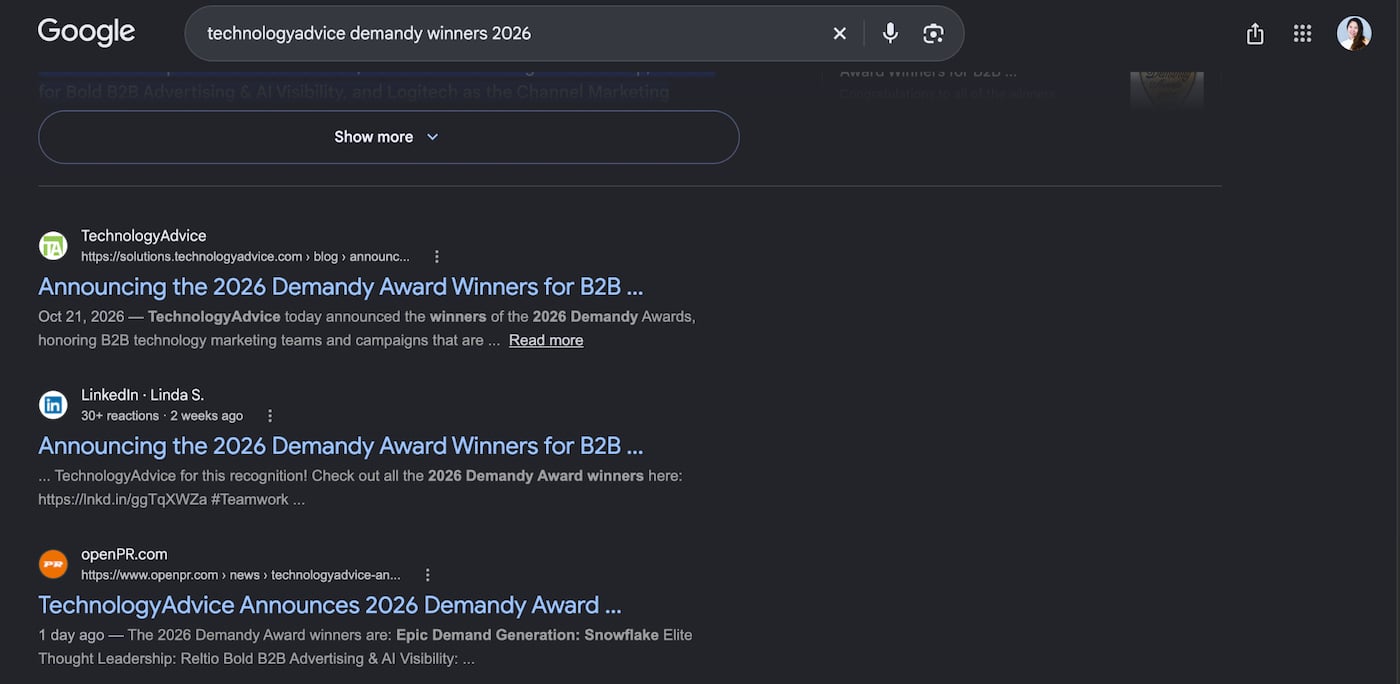
I submitted the same TechnologyAdvice award announcement through OpenPR’s and PRFree’s free options. Both published it without a paid upgrade. I documented the submission requirements, confirmation steps, publication dates, and what appeared when I searched Google for “technologyadvice demandy winners 2026.”
OpenPR’s form was straightforward, but its separate email approval step caused confusion. PRFree required account setup and verification, then provided a clear publication confirmation after submission.
OpenPR also appeared in my branded Google search, while I did not find PRFree’s release using the same phrase. However, OpenPR’s release was published two days earlier, so the search comparison was not conducted at equal intervals after publication.
Both services provided a published release page. This test did not verify additional media placements, referral traffic, or SEO improvements. Search positions can change, and not finding PRFree for this query does not establish that its page was unindexed.
OpenPR’s release appeared third on page one of my Google search for “technologyadvice demandy winners 2026.”
What makes PRLog the overall best free press release distribution service?
What makes IssueWire the best for multimedia-rich releases?
What makes EIN Presswire the best for one-time broad distribution?
What makes OpenPR the best for monthly search visibility?
What makes PR.com the best for industry and regional targeting?
What makes PRFree the best for search and social visibility?
What makes 1888PressRelease the best for basic release hosting?
What makes CircleActs the best for nonprofit press releases?
Press release submission checklist
Use this checklist to prepare your announcement, complete the service’s confirmation steps, and document what happens after submission.
Before submitting
☐ Identify the news: what happened, who it affects, and why it matters now.
☐ Verify names, dates, statistics, quotes, and supporting links.
☐ Prepare the headline, summary, release body, and company description.
☐ Check character limits, link allowances, formatting rules, and image specifications.
☐ Prepare public-facing business contact details and any required postal address.
☐ Confirm content eligibility, including restrictions on previously published or exclusive news.
☐ Select the free option and note which features require payment.
During submission
☐ Complete account or email verification.
☐ Choose relevant categories and tags.
☐ Review the preview or completed fields before submitting.
☐ Record the submission date and retain the confirmation.
☐ Complete any separate approval request sent by email.
After submission
☐ Check that the release is publicly accessible.
☐ Save its URL, displayed publication date, and a screenshot.
☐ Inspect the headline, body, links, and contact details for errors.
☐ Record the exact query and check date when assessing search visibility.
☐ Verify additional placements individually and distinguish them from the provider’s own page.
☐ Track referral visits separately if analytics are available.
A publication page confirms that your release is online. Media coverage, search visibility, and website traffic require separate evidence.
Frequently asked questions (FAQs)
What is the best press release distribution service?
PRLog is the best free option in this guide. It supports ongoing free publishing, search and feed distribution, multimedia, basic targeting, and a hosted company press room.
For a one-time announcement requiring broader reach, consider EIN Presswire. IssueWire is a strong alternative for image- or video-rich releases.
Can ChatGPT write a press release?
Yes. Provide details about the announcement, company, target audience, supporting facts, quotes, and desired tone to generate a first draft.
Review the result for accuracy, newsworthiness, formatting, and brand voice. Verify every name, date, statistic, quote, and contact detail before distribution.
Is press release distribution free?
Some providers offer free publishing or limited distribution. PRLog, PRFree, and 1888PressRelease.com accept ongoing free submissions, while CircleActs is free for eligible nonprofits. OpenPR allows one free release every 30 days, and IssueWire and EIN Presswire offer one introductory release.
Free services generally provide less reach, targeting, reporting, and support than paid packages.
Is it a good idea to use a free press release distribution service?
Yes, for routine announcements, shareable release pages, or businesses with limited PR budgets. Free platforms can also help maintain an online archive of company news.
Consider a paid service for major announcements requiring broader reach, audience targeting, faster publication, detailed reporting, or journalist outreach. Neither free nor paid distribution guarantees media coverage.
Bottom line
Free press release services can provide a public page for a business announcement, but publication is only one outcome. In my OpenPR and PRFree tests, both services published the release at no cost; additional media placements and traffic gains were not established.
Choose a service based on its submission requirements, included features, and documented reach. Use the checklist above to prepare your release and record the results.
Bianca Caballero is a sales and customer experience writer with a background in B2B and B2C growth across the health, pharmaceutical, and insurance space. She brings a practical perspective on how go-to-market teams are adopting AI tools and automation to improve prospecting and pipeline development. Her work explores how emerging technologies are reshaping sales and marketing workflows
Loading more content…
Our mission is to provide small business owners with the information you need to succeed. Learn how to start, market, run, and grow your business today!
Advertiser Disclosure: Some of the products that appear on this site are from companies from which TechnologyAdvice receives compensation. This compensation may impact how and where products appear on this site including, for example, the order in which they appear. TechnologyAdvice does not include all companies or all types of products available in the marketplace.